
A tiny Outlook add-in that lets you pin a note to any mail, conversation, or appointment — kept as a real file on disk, opened in the editor you choose, and flagged with a colored category so you can spot at a glance which items carry a note.
Why I Built This
My inbox is my memory, and that is exactly the problem. Some mails need a little something attached to them — a quick thought, a follow-up, the outcome of a phone call, a checklist for later. Outlook can flag and categorize an item, but it cannot hold the actual content of that thought where I want it: in a plain, portable file I can open in my own editor, search on disk, and keep in OneDrive so it follows me between machines.
So years ago I built GimmeNote: click a button on a mail, and a note file opens in your editor of choice. Close it, and the mail is quietly marked with a colored category so you always know it has a note. Delete the note, and the mark disappears. It is a small idea, but it turned out to be one of those tools I reach for every single day.
The original GimmeNote was a classic Office VSTO add-in with a ClickOnce installer — the kind of thing that wants a setup bootstrapper, an internet connection, and a background updater. It worked, but it always felt heavier than the simple job it did.
Then came vibe coding with Claude. With the help of Claude Opus, GimmeNote shed its VSTO skin and became a lightweight, per-user COM add-in that installs with a single script and no administrator rights — and along the way it grew a self-writing default configuration, smarter editor launching, and much clearer diagnostics. Most of the work was a conversation: I described what annoyed me, and the add-in got lighter and sharper, one step at a time.
What Is GimmeNote?
GimmeNote is a small Microsoft Outlook add-in that adds a note option to mail items, whole conversations, and calendar items (appointments and meetings). Each note is a normal file — RTF, TXT, or whatever extension you prefer — stored in a folder of your choosing and opened in your editor of choice. GimmeNote itself stays out of the way: it just creates the file, opens it, and keeps the mail marked so you know the note is there.
It is designed to work with your primary Exchange mailbox, where Outlook categories are available. Creating notes also works on secondary accounts, though the colored flagging relies on categories, which not every account type supports.
Three Buttons, Everywhere You Need Them
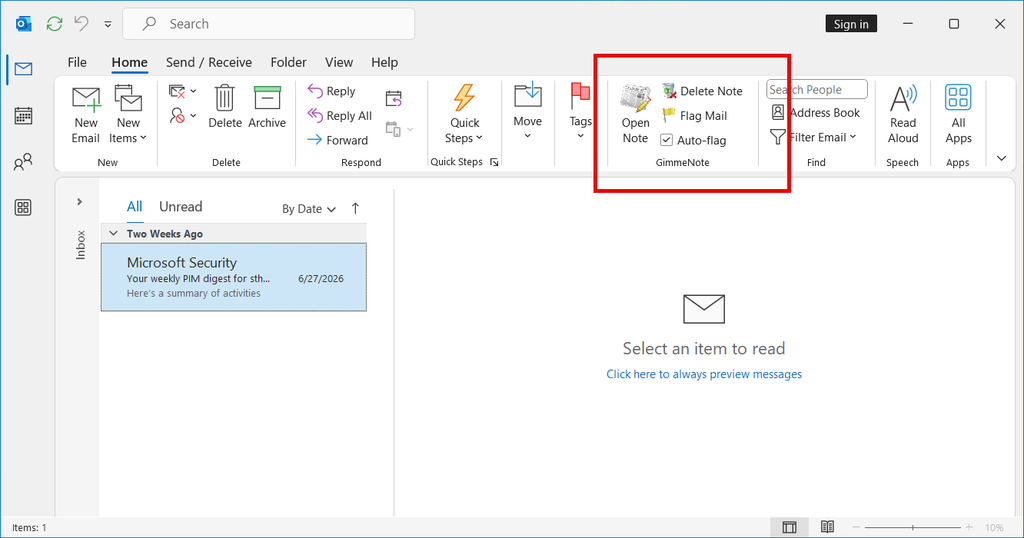
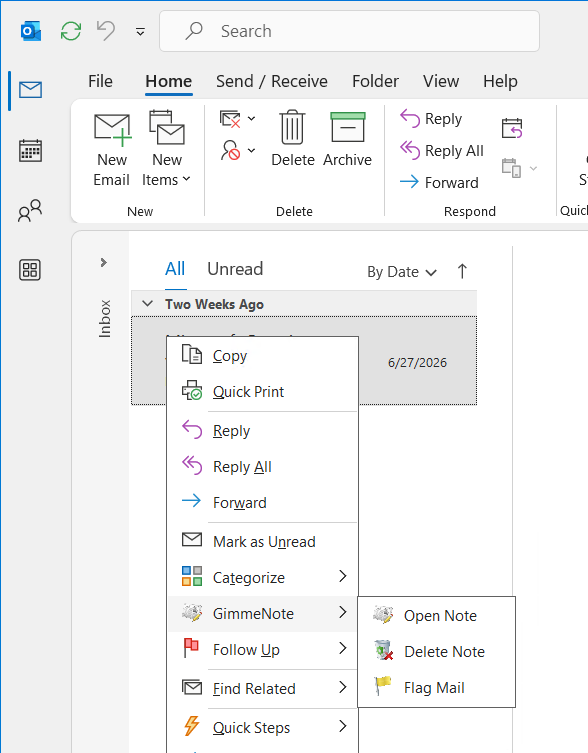
GimmeNote adds a small, focused set of controls, and puts them everywhere you would reasonably look for them: on the main ribbon in the mail list, on the tab of an open message, on the tab of an open appointment or meeting, and in the right-click context menu of a mail item.
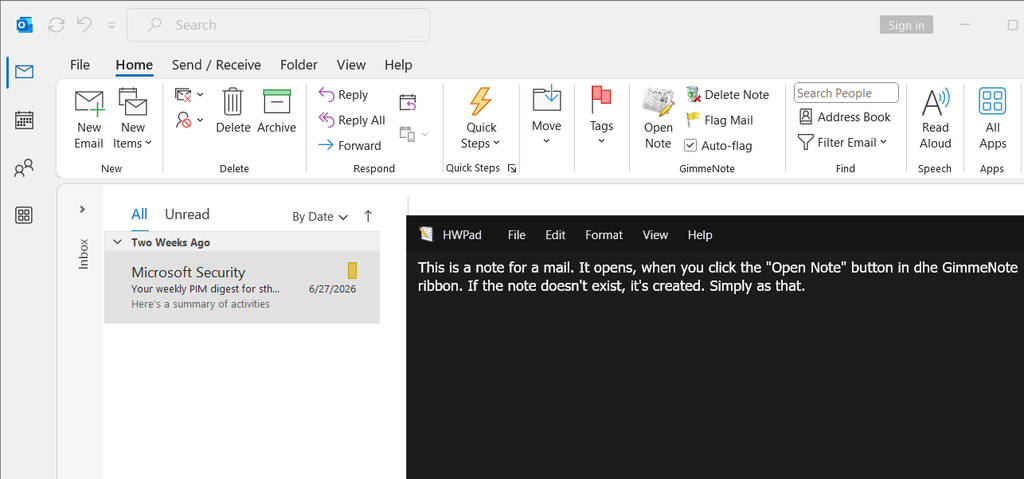
- Open Note — creates the note file if it does not exist yet and opens it in your editor. Click it again later and the same note reopens.
- Flag Mail — toggles the GimmeNote category on the item by hand, whenever you want the mark without a note (or the note without the mark).
- Delete Note — removes the note file and clears the mark.
Your Notes, Your Editor
This is the heart of GimmeNote: your notes open in your editor, not in whatever the system happens to feel like. Out of the box, GimmeNote opens each note with the application Windows associates with the note’s file type — so a .rtf note lands in your default rich-text editor and a .txt note in your default text editor. It figures out the actual program behind that association and launches it directly with the note file.
If you want something specific, you can point GimmeNote at any editor you like. Set the NoteApplication registry value to the full path of the program and, optionally, NoteApplicationArguments to control how the file is passed to it. The special placeholder %NoteFile% is replaced with the full path of the note — quoted automatically when the path contains spaces, so you never have to fuss with that yourself.
- Default — leave
NoteApplicationat%DefaultApp%and each note opens in the app registered for its extension. - Custom editor — set
NoteApplicationto, say, Word or your favorite text editor, and every note opens there.
The file type itself is up to you as well: NoteExtension decides whether new notes are created as .rtf, .txt, or anything else. Rich text keeps a little formatting; plain text keeps things simple and searchable.
Auto-Flag: See Your Notes at a Glance
A note you cannot find is a note you did not write. GimmeNote solves that with Outlook categories: when Auto-flag is on, creating a note automatically tags the mail with a colored GimmeNote category, and deleting the note removes it again. A quick glance down your inbox instantly tells you which items carry a note.
There is a checkbox for it right in the ribbon group, so you can flip auto-flagging on or off at any time without touching a settings file. Mail-bound notes and conversation-bound notes get their own separate categories — GimmeNote and GimmeNoteThread by default — each with its own color, so the two kinds of notes are easy to tell apart. Both the names and the colors are configurable if the defaults do not suit you.
Notes for a Whole Conversation — and Notes from the Mail Itself
Two small modifier tricks make GimmeNote punch above its weight, and both live on the Open Note button:
- SHIFT-click creates a conversation note: instead of binding the note to a single message, it binds it to the entire thread, so every mail in that conversation shares the same note. Optionally, the very first mail of the conversation is the one that gets flagged, so the mark stays put at the root of the thread.
- CTRL-click pre-fills a brand-new note with the body of the mail, so you start from the message’s own text rather than a blank page. It applies when the note is first created and works for RTF and plain-text notes.
Tip: Click Open Note for a normal per-mail note, SHIFT-click to attach one note to the whole conversation, and CTRL-click to seed a new note with the mail’s body.
Where Your Notes Live
All note files are stored in a single folder set by the NotePath value. By default GimmeNote uses a GimmeNote sub-folder inside your Documents, and it creates that folder for you on first start. Because NotePath is stored as an expandable value, you can use environment variables in it — which makes one particular setup genuinely useful.
Point NotePath at a OneDrive folder and your notes roam with you: the same notes appear on every machine where you use Outlook, kept in sync in the background. It is the closest thing to “my notes are just always there,” without any server of my own to run.
The file names are designed to be human-friendly. Each note starts with a short hash that ties it to the mail, followed by a marker for a single mail or a conversation and then the subject — so you can browse the folder and recognize notes at a glance. If you would rather not have subjects visible in file names, one setting switches to a pure hash instead, and another controls how much of the subject is used.
Configuration That Configures Itself
GimmeNote reads its settings from the HKCU\Software\GimmeNote registry key, but you rarely have to touch it. On its very first start, the add-in writes a sensible default configuration for you — auto-flag on, note files created as needed, conversation binding enabled, the default editor via %DefaultApp%, plain-text notes, and the Documents note folder. Existing values are never overwritten, so anything you have set by hand is left exactly as it is.
From there, everything is a registry value you can tweak: the editor and its arguments, the note extension and folder, the category names and colors, the file-naming style, and small behavioral options. Changes take effect after the next Outlook restart.
The Big Change: Goodbye VSTO, Hello a Lightweight Add-In
The most important part of the 2026 rebuild is invisible in daily use but changes everything about deployment. GimmeNote is no longer a VSTO/ClickOnce solution. It is now a plain, per-user COM add-in — a single signed DLL that registers itself for your account only, with no installer, no bootstrapper, no internet download, and no administrator rights required.
Installing it is refreshingly boring: unzip the files into a folder, close Outlook, and run the included Register.ps1 script. That registers the add-in for the current user and, on first launch, GimmeNote seeds its own defaults. Removing it is just as clean — run Unregister.ps1 and the registration is gone, while your notes and settings stay untouched.
- No installer, no admin — everything happens under your own user account.
- Updating is a copy — replace the DLL with a new build and restart Outlook; re-run the script only when the version or location changes.
- Your data is yours — notes and settings live outside the add-in and survive install, update, and removal.
When Something Misbehaves: The Built-In Log
GimmeNote can keep a detailed diagnostic log, which turns a vague “it did not open” into a precise, fixable cause. It is opt-in: set EnableLog to 1 and GimmeNote writes a timestamped GimmeNote.log that traces each request step by step — which item you clicked, how the note file name was built, which editor was resolved, and the exact command that was launched.
When a launch fails, the log now records the precise Windows error code behind it, so you can tell apart a missing file, a missing file association, and a launch blocked by a corporate security policy at a glance. GimmeNote can also write essential events to the Windows application event log. Because creating the event-log source needs elevation, that one step can be done once from an administrator PowerShell window:
New-EventLog -LogName "Application" -Source "GimmeNote"
A Few Power-User Touches
Because it grew out of daily use, GimmeNote hides a couple of small conveniences for when you need to look under the hood:
- SHIFT + CTRL + ALT + Flag Mail shows the current add-in version and where it is running from — handy for confirming an update took.
- CTRL + ALT + Flag Mail dumps the selected item’s properties to the log, which is oddly satisfying when you are curious what Outlook actually stores.
Where It Stands Today
What began as a small VSTO experiment has, with a lot of help from Claude Opus, turned into something leaner and friendlier: a per-user add-in you install with a script and no admin rights, notes that open in the editor of your choice, auto-flagging with colored categories, conversation notes, mail-body seeding, OneDrive-friendly roaming storage, a configuration that sets itself up on first run, and a clear diagnostic log for the rare day something needs explaining.
It is still a small, focused add-in by design — it does one job, attaching a note to an Outlook item, and tries to do it so smoothly you stop thinking about it. That is exactly the point.
If you have ever wished you could just staple a proper note to a mail and find it again later, GimmeNote is my answer to that wish.
Updates
The article above describes GimmeNote as of version 2.5. New versions and their changes are logged here.
Version 2.6.0.0 — July 2026
- Copy the mail into a note as HTML. Holding
CTRLwhile clicking Open Note has always pre-filled a new note with the body of the mail. It now supports a third format — HTML — alongside plain text and rich text, so the mail content can land in an HTML editor such as HWPad with its formatting intact. - The format follows your note extension. GimmeNote picks the paste format from the note’s file type:
.txtcopies plain text,.rtfcopies rich text, and.html/.htmcopies the HTML body. Any other extension falls back to plain text. - Graceful fallback. When the mail does not offer the requested format — for example a plain-text mail has no RTF or HTML body — GimmeNote quietly falls back to plain text and notes it in the log, so you always get something rather than an empty note.
- Signature details in the info box. The hidden diagnostic box (
SHIFT + CTRL + ALTwhile clicking Flag Mail) now also reports whether the add-in is digitally signed, and if so, the signing certificate’s subject, issuer, validity period and thumbprint — a quick way to confirm you are running a properly signed build.
© 2026 by Helmut Wagensonner. GimmeNote is a personal project. All product and company names are trademarks of their respective owners.